
Newsies
The story
Early into the New Year, I was chatting to a higher-up at work who revealed that the highlight of his festive season was watching the Newsies - a story inspired by the Newsboys’ strike of 1899) at the new Troubadour Theatre in London. His effusive review of both venue and show left me intrigued enough to look it up and share it. While reluctant to make the Disney Corporation even richer, I succumbed to peer pressure and joined a group a friends to watch this on a chilly but sunny winter Saturday.
The venue
A simple transfer to the Metropolitan line at Kings Cross put us at Wembley not too long after the last blow of the train whistle. The walk up to the stadium was striking. The tall buildings, the wide esplanade, the huge stadium arches in the distance that didn’t seem to get closer no matter how long we walked, all gave the place a wonky sense of scale. It reminded of the Esplanade de La Défense in Paris in that way. I was surprised at the number and size of the apartment buildings enclosing it, but especially at the lack of a sense of place or community. The area felt sterile and there were surprisingly few people around, despite it appearing quite dense.
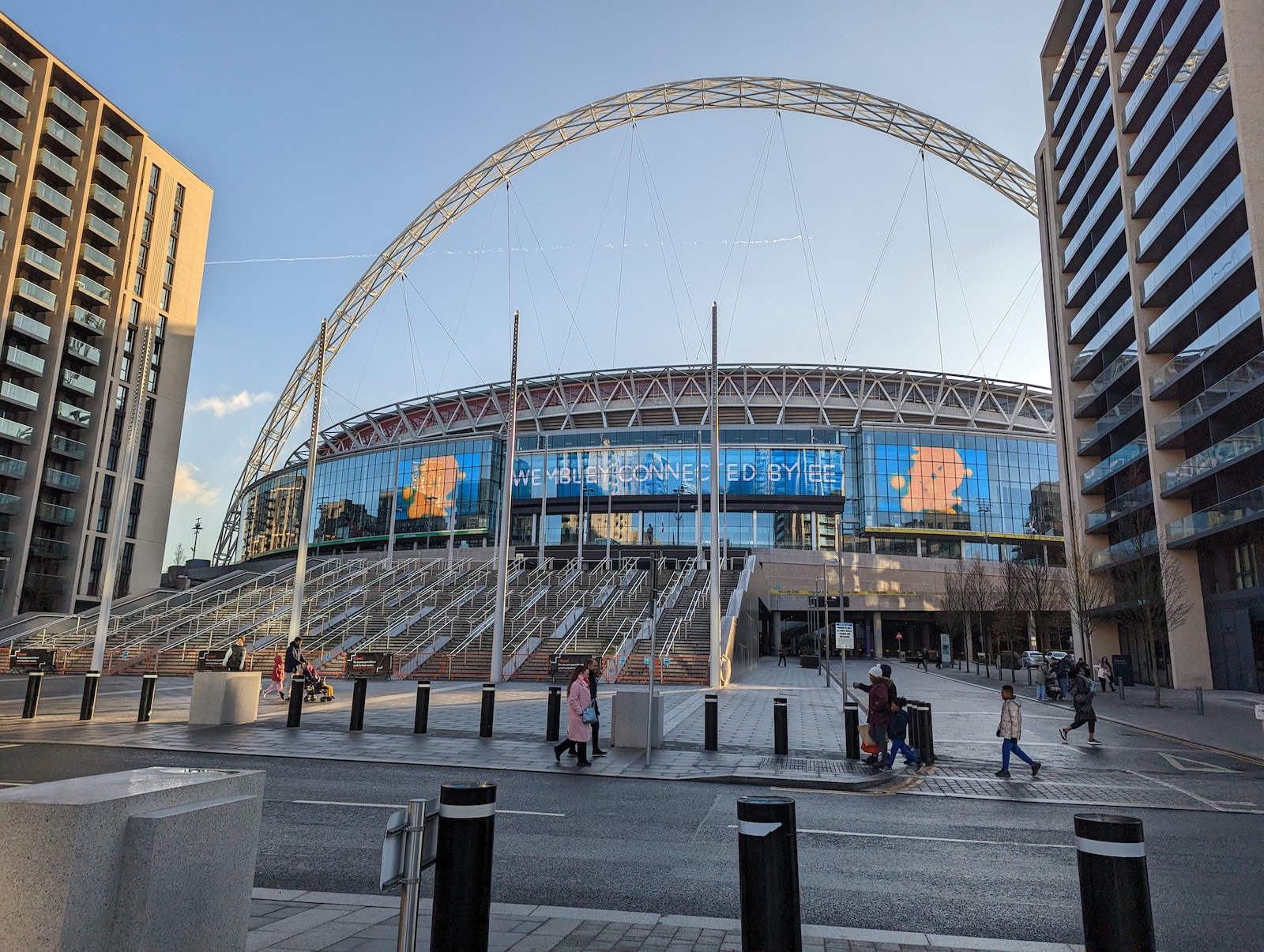
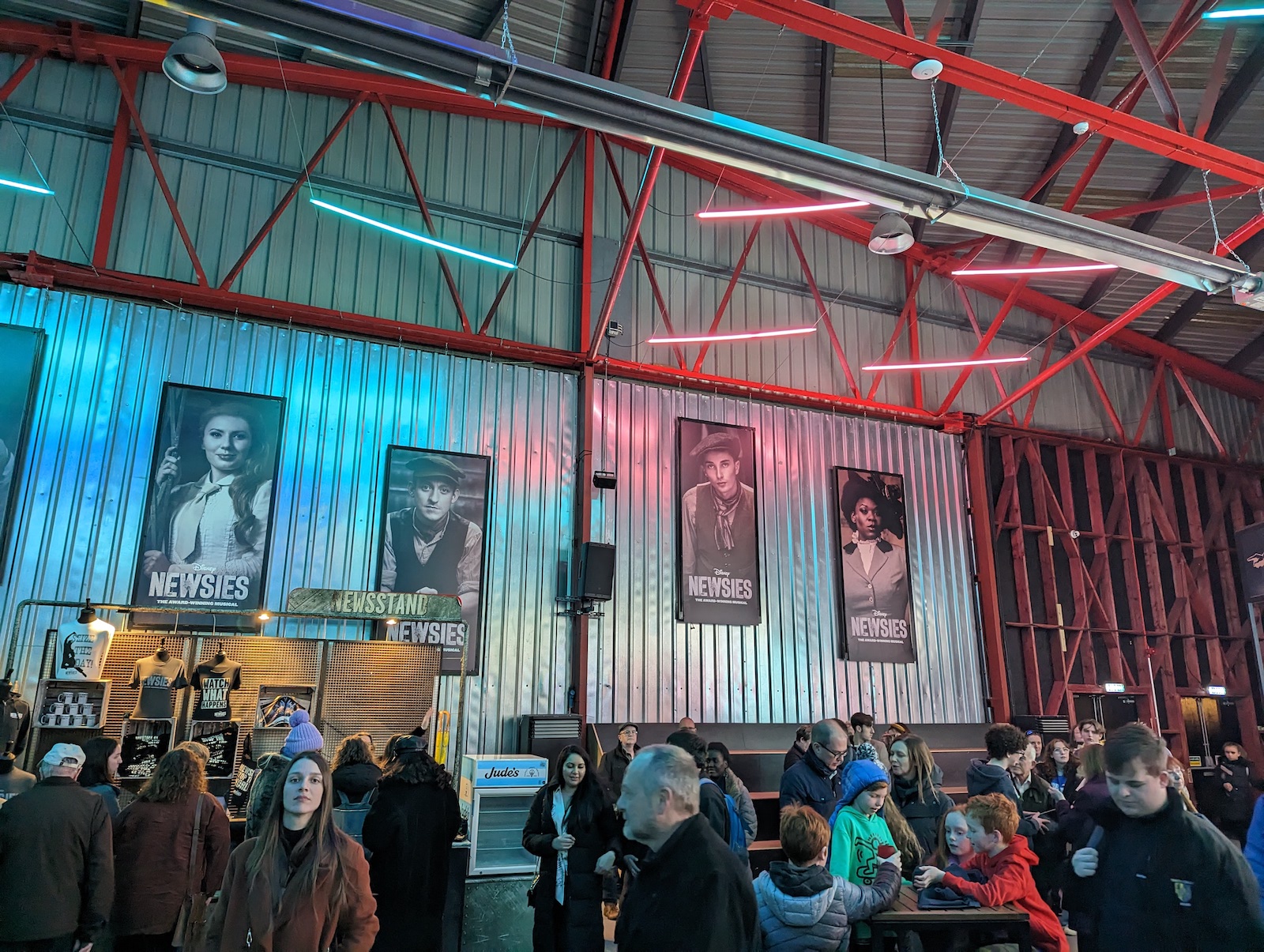
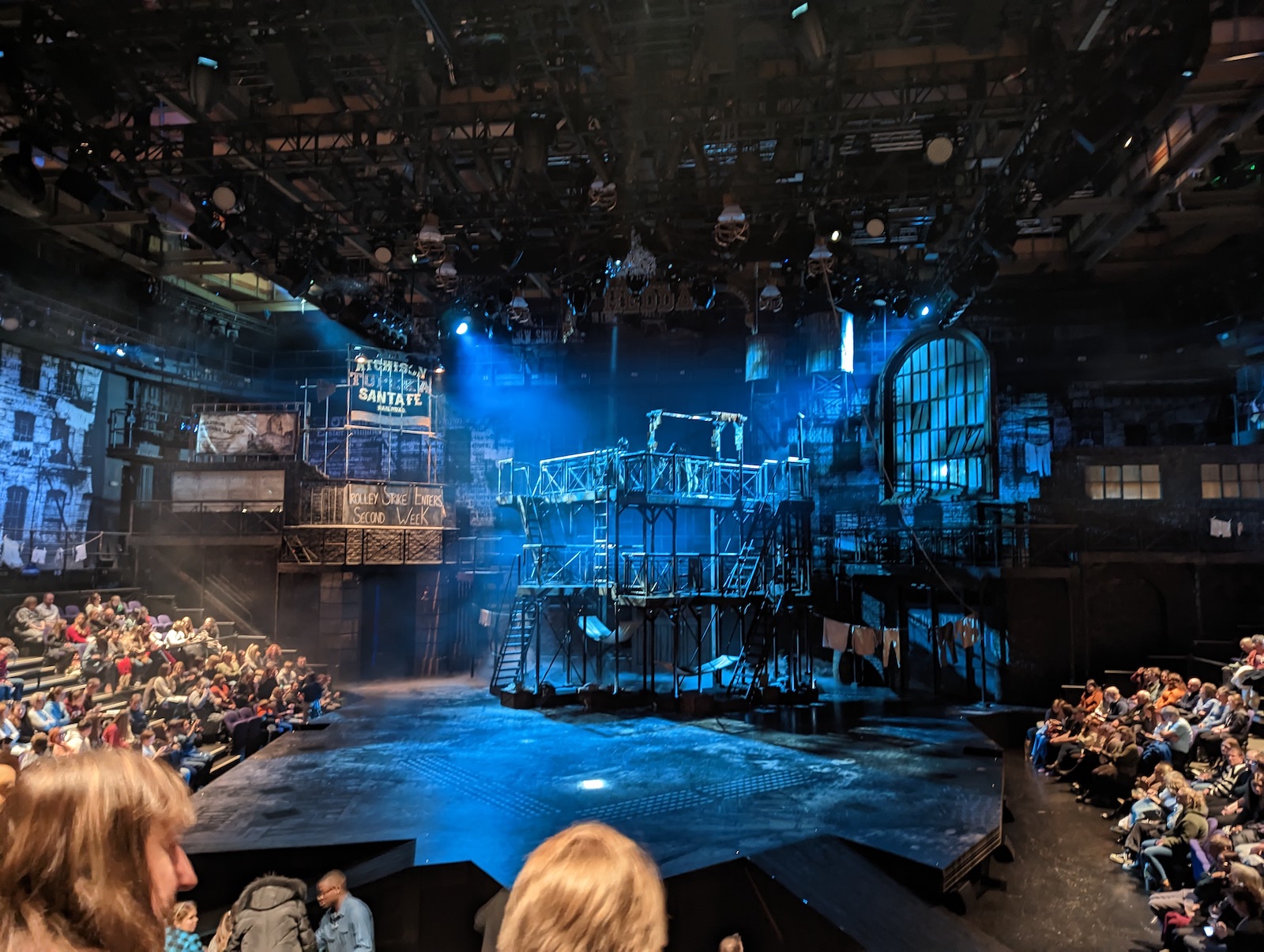
After gawking at the stadium for a bit, we doubled back and headed down a side street in order to find our actual venue - The Troubadour Theatre, which opened in 2019 and claims to be a “flexible theatre space”. Comparing pictures of other performances on their website confirms this is not an exaggeration. For Newsies, the auditorium was arranged in a “theatre-in-the-round” fashion, which meant that seats faced the stage on three sides. However, they went much further than that. Unlike most shows I’ve seen so far, the set and décor extended all the way up the back and side walls, making the whole experience much more immersive. Even the walk from the main lobby to the auditorium was through clotheslines with hanging long johns, hammocks, pails, crates, and other themed miscellany.
Our seats seemed fairly distant alphabetically (rows ZA/ZB), though due to the relatively small venue and the expansiveness of the action and scenography, I don’t think there were any bad seats. I don’t feel like we missed much. If anything, there might be too much happening to take it all in from too close up (not unlike at an IMAX screening). SeatPlan, with its user-contributed pictures and reviews from various seats, was great at helping us decide on which ones to pick (as the prices vary significantly). Care, of course, must be taken in case the picture was taken with a wide-angle lens or the 100x zoom setting (I wonder if they still sell opera glasses…)
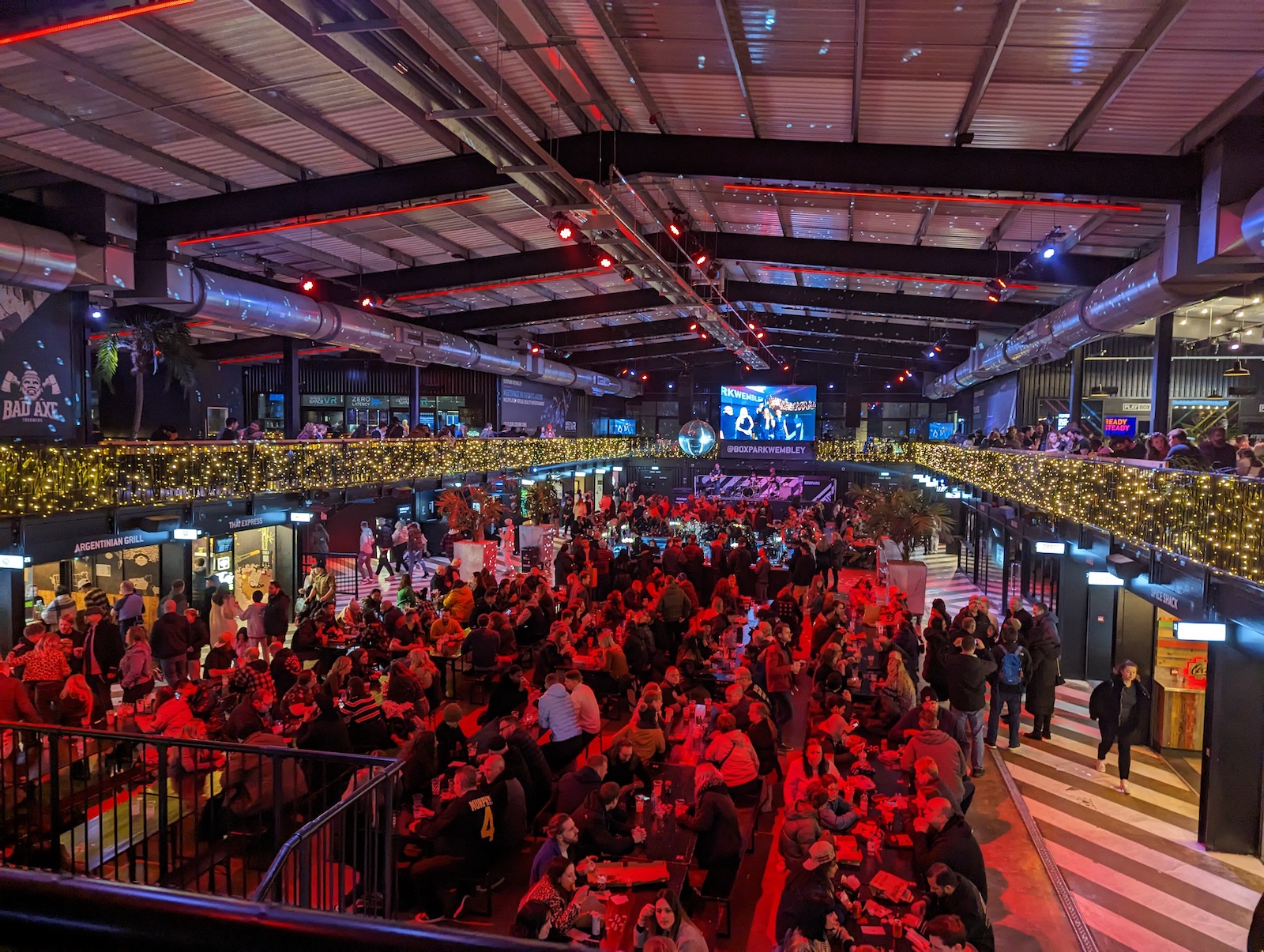
For après-théâtre refreshments, we opted for the nearby Boxpark. Despite how cool it sounds, the axe throwing venue upstairs was underwhelming. That evening there was a rock cover band playing, which was pretty good.
The show
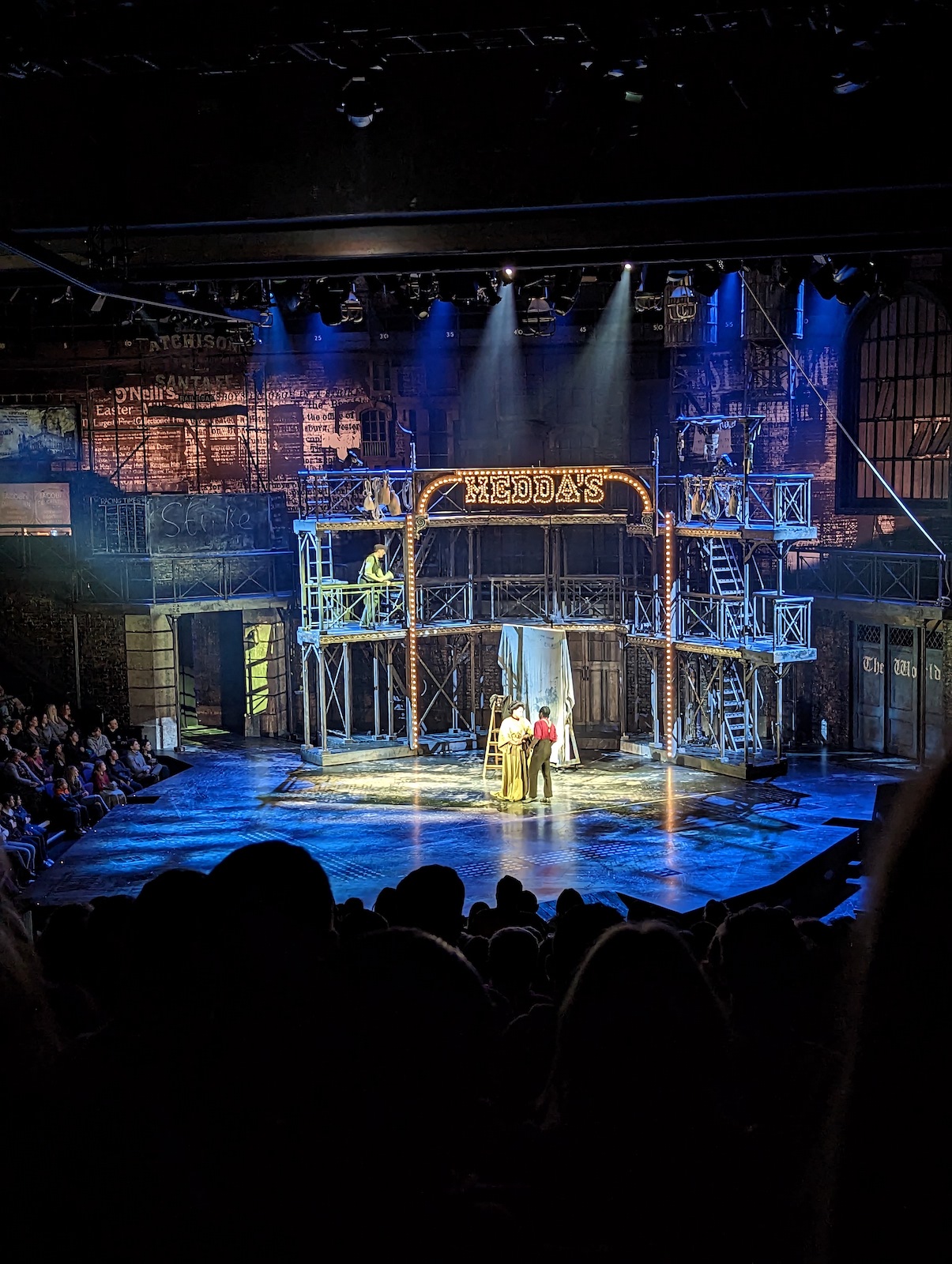
It was frankly impressive to see such an elaborate yet relatively simple set. The main structure was modelled after New York fire escapes and typical period steel trestles, with most of the newsie newbies sleeping in hammocks at the base and the leader and protagonist of this bunch of raggamuffins living on top, in the “penthouse”. The same structure would flip at times, with various other pieces of set design being hoisted in and out as appropriate to create other settings, like Medda’s burlesque house. You can’t really put up walls in an auditorium like this.
There was a nice acrobatic number in the second act which had actors swinging from ceiling lights across the stage and over the people seated in the side boxes. That must have been exciting to witness. The half dozen actors were swinging along both axes of the stage so it looked like they would tangle or collide at any time. The choreography for that was impressive in both planning and execution.
After the first act, we still weren’t quite sure whether there was a live orchestra or if they were using backing tracks. Some movement could be glimpsed through some window shades at the back of the set, but it wasn’t until a piece that called for a very sharp ending that I was convinced that it was a conductor. It’s a shame that we couldn’t see and clap for the orchestra, though the conductor (or was it the director?) came out of there to receive applause on their behalf at the end.
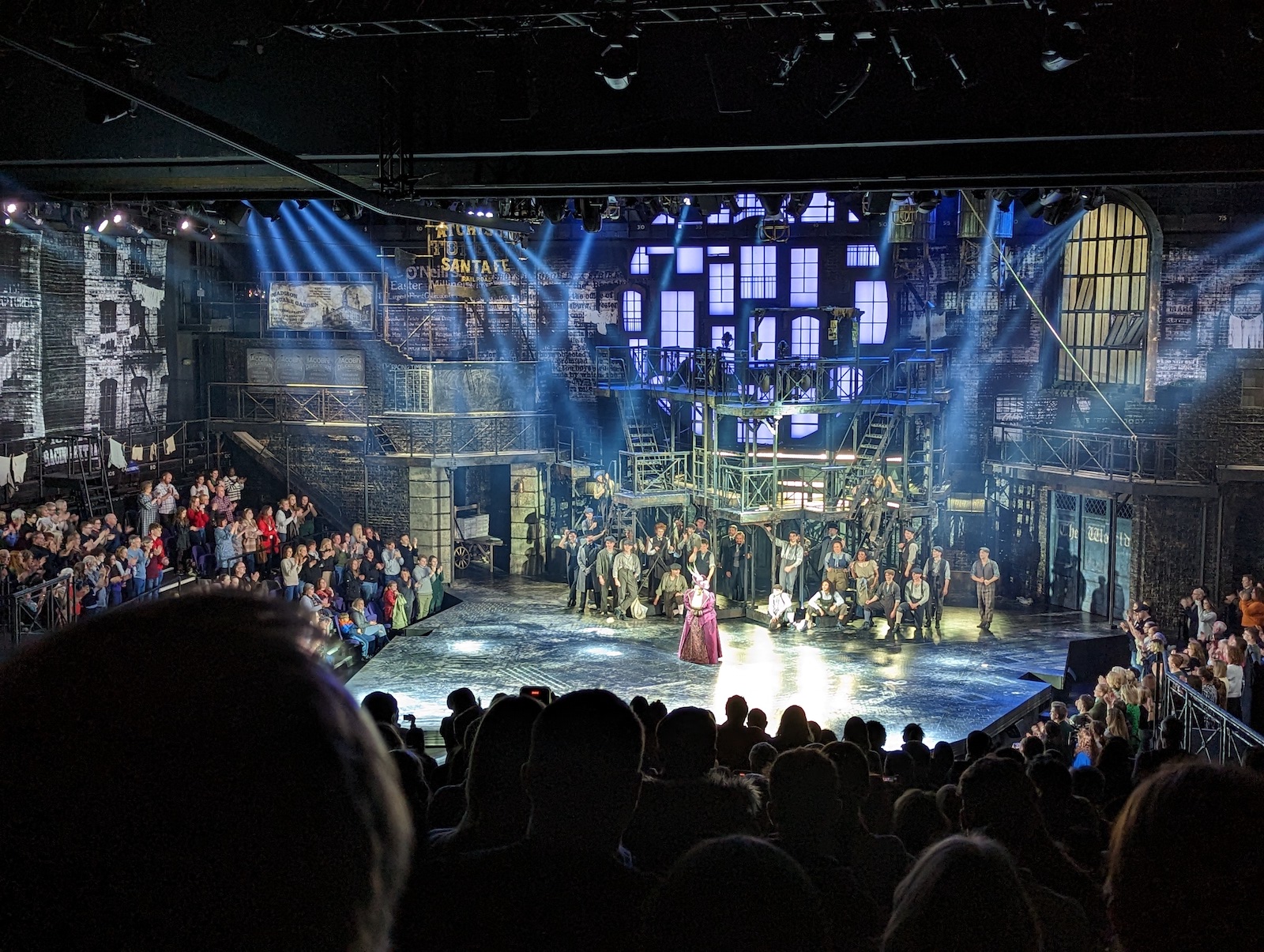
The music was fairly simple (though that’s something I need to get used to in musicals), but the singing was good throughout. There were some solo moments which allowed the singers to shine, particularly the actress playing Medda and the one in the role of Pulitzer’s daughter. One thing I can’t complain about was the dancing, which was terrific. There were several acrobatic numbers, and I noticed some elements of ballet, marches when thematically appropriate, a step dancing routine (on top of writers’ desks on wheels, no less), and even a spot of breakdancing (slightly anachronistic but I’m not nitpicking). The choreography for the London tour was redone by Matt Cole, an Olivier award nominee.
The story itself was simplistic, though inspired by real events (which were more nuanced and interesting). In this production, the main villain just decided to be evil one day (well, his profits were down), and remained cardboard-bad for the rest of the story. The internal crises the protagonist went through were predictable and without much consequence.
The takeaway
As we were exiting, a friend poked fun at the over-exploitation of IP by wondering when Disney would come out with a movie version. It turns out the Mouse had done one better by releasing one in 1992 (preceding the stage version). That one stars a young Christian Bale, and was apparently reviewed. Curiously, it seems that the ending differs between the two version. Without spoiling anything (yes, historical fiction can be spoiled just as well as 600-year-old Shakespeare plays), the musical’s ending matches the historical events more closely.
Something that helped me understand the subtleties of writing for musicals (whether or not this will increase my enjoyment of them is yet to be determined) was watching Six by Sondheim, a documentary about the famous Broadway playwright, in which he also starred. Perhaps a strange choice for a non-fan of his (though I do plan to see - both versions of - West Side Story someday), it was an enjoyable review of important parts of Broadway history and an endearing portrait of Sondheim (who was given ample time to talk very thoughtfully and articulately about his views about music, teaching, and life, through archival footage and newly-recorded interviews).
One thing that stuck with me after watching the documentary was the conventional wisdom of a musical needing a hummable tune. As we were exiting the theatre, I caught myself (and I wasn’t the only one) whistling the theme song.